If Dennis Tito has his way, two people will leave our planet in January 2018 and make a trip to Mars and back. Tito will be footing much of the bill himself.Yes, he has the money and plan.
This mission won?t stop at Mars, but rather, will do a quick flyby.? Unlike the spate of space commerce companies that have flashed on and off the news in recent months, this effort has substantial cash behind it ? at the onset. Also, unlike these previously announced efforts, this is not being done by a company that needs to eventually return a profit to its investors. Instead, it is being spearheaded by a non-profit organization, the Inspiration Mars Foundation.
Titled ?Feasibility Analysis for a Manned Mars Free-Return Mission in 2018?, this paper is due to be presented at the 2013 IEEE Aerospace Conference on 3 March 2013 at 9:50 pm. This paper has been widely circulated for several weeks by the authors and their associates within government, legislative, industry, and advocacy communities, and has been referenced online ? in great detail ? for more than a week.The core premise of this initial mission concept is to use an upgraded SpaceX Dragon capsule as the habitable volume for the entire mission. This spacecraft would be launched on a SpaceX Falcon Heavy and follows an optimized free-return trajectory to Mars and back. As outlined in the paper, this conceptual mission would depart Earth on 5 Jan 2018, reach Mars on 20 August 2018, and return to Earth on 21 May 2019.

The closest that the spacecraft would get to Mars would be ~100 km ? and the crew would only spend 10 hours within that distance of the planet ? with closest approach on the night side. Not too different than the first human mission to the Moon when all things are taken into account. Image Source: Tito et al.
Upon return, the Dragon capsule would use Earth?s atmosphere to slow down via aerobraking. This has never been done with a human mission before. Ten days after aerobraking the Dragon capsule would return again to Earth and reenter at 14.2 km/sec. This would be the fastest reentry by any crewed spacecraft ? ever. As such, this mission will require some advanced Thermal Protection System research. To that end Paragon/Inspiration Mars have already signed a reimbursable Space Act Agreement with NASA Ames Research Center. A check for $100,000 has already been presented to NASA to begin this work.
Since this IEE paper began to circulated, the Inspiration Mars Foundation has started to look at other mission concepts using different spacecraft and launch vehicles. As with the IEEE paper, the focus has been to use things that either exist or are expected to become available in the next several years.
A Tight Fit
The Dragon-based mission concept would require rather cramped quarters. Indeed the paper says: ?The ECLSS was assumed to meet only basic human needs to support metabolic requirements of two 70 kg men, with a nominal metabolic rate of 11.82 MJ/d. Crew comfort is limited to survival needs only. For example, sponge baths are acceptable, with no need for showers ? Personal provisions are limited to items such as clothing and hygiene products.?
In the weeks after this paper was submitted, Inspiration Mars has been looking at other concepts including an inflatable module placed at the nose of the crew capsule ? something similar to what Bigelow Aerospace will be putting on the International Space Station (ISS). In order to limit use of internal volume, the mission concept also does away with all EVA provisions (spacesuits etc). This means that there is no way to fix things ? or install things outside of the spacecraft ? thus requiring all systems to be serviceable from inside the spacecraft. If this no-EVA approach is taken, then adding inflatable modules to the front of the crew capsule becomes problematic. Regardless of the final design they adopt, mass limitations are likely to force that final design to be rather cramped.
The initial SpaceX hardware concept uses only one launch. Adopting a mission that uses more than one launch increases cost and complexity. But that?s nothing new. How much will it cost? Who knows. They have not settled on a mission architecture yet ? but this will probably be in the hundreds of millions/half billion dollar range by the time it is all figured out. Again, unlike all the other space projects that have sprouted of late, Tito is a very wealthy man and is prepared to write some rather large checks. That fact alone moves this idea from giggle factor to the verge of credibility. Tito can afford to spend significant sums to figure this out. But, given the calendar aspects of his mission, he does not have time on his side.Given the compressed schedule, assuming a launch in January 2018, one would assume that the mission design would need to be done very quickly and completed certainly no later than a year from now. Launch vehicle selection would likely need to be done in a similarly prompt time frame. Whatever rocket(s) are chosen, they need to be ordered and built. Unlike many missions, these trajectories have constrained launch windows that don?t lend themselves to delays. As such development time will be highly compressed.
Based on this tight schedule and cost limitations it is rather unlikely that a full-up test mission will be possible to test everything out beforehand. As such, it would seem that the first time that the fully integrated and operational Inspiration Mars mission hardware flies will be the actual mission itself. Once the crew deaprts there is no turning back. This is somewhat risky to say the least. Its like putting a crew and full passenger load on a new jetliner design for its very first flight and then sending it off on an intercontinental mission with only one option: land at the final destination.
Already Tested
While we have all become risk adverse these days, this would not be the first time something like this is done in space. The Space Shuttle had four drop tests off of a Boeing 747 to see if the shuttle design would glide and land. The first time a Space Shuttle actually went into space and back was on a real mission ? with a real crew. But the real similarity can be found in the Apollo 8 mission. A crew was put inside a spacecraft that had only flown once atop a booster that had only been flown twice before, on a trajectory to the Moon ? with only one engine to modify its path. As was seen on Apollo 13, there was a razor thin margin of possible response to the failure of that propulsion system ? an option that was simply not available on Apollo 8.

Millionaire space tourist Dennis Tito wants to send a married couple to Mars within five years.
The IEEE paper spends a lot of time discussing various life support (ECLSS) concepts, but does not seem to refer to specific hardware already in use on the Dragon or elsewhere as being proposed for use on this mission. Add in the reliability and servicing/repair requirements and is probably safe to assume that many of the designs will be more or less unique to this mission. Without a chance to fly the vehicle in space, one would expect that a rather robust ground-based engineering version (perhaps several) would be needed.
The paper does make short mention of radiation ? but only in a general sense saying that it will be provided for. Given that Jon Clark is involved, you can be certain that this issue is not going to be overlooked. While the mission?s trajectory has been optimized for a 2018-2019 mission due to celestial mechanics, it has the unfortunate fact of falling in the middle of a period of minimal solar activity.
Cosmic Shield
In orbits close to the Earth, such as occupied by the International Space Station, Earth?s geomagnetic field offers significant protection against Galactic Cosmic Radiation (GCR) and energetic solar flare protons. As such, crews on the ISS, while exposed to more radiation than on Earth, are none the less protected to a great extent when compared to regions outside Earth?s magnetic field. Shielding and storm shelter locations allow greater protection when conditions warrant ? and in a potentially lethal solar event scenario, they could come home in a matter of hours.
Outside the Earth?s magnetic field, there is some lesser level of protection still offered due to the activity of the sun itself. However, during a solar minimum, the point in the 11 year solar cycle when the sun?s activity is lowest, the sun?s ability to ward off CGR is at its lowest. As such, possible exposure to astronaut crews traveling in interplanetary space is at its highest.
Some predictions for Solar Cycle 25 suggest an unusually quiet period for the sun. If things continue as predicted, the sun would be reaching its lowest activity levels of the space exploration era during the planned timeline of this mission, thus presenting the highest level of potential GCR exposure to the crew. Add in the unusual quiescence of the sun, and this could be especially hazardous. Again, this can be handled with shielding but that requires mass and volume which is already preciously short.
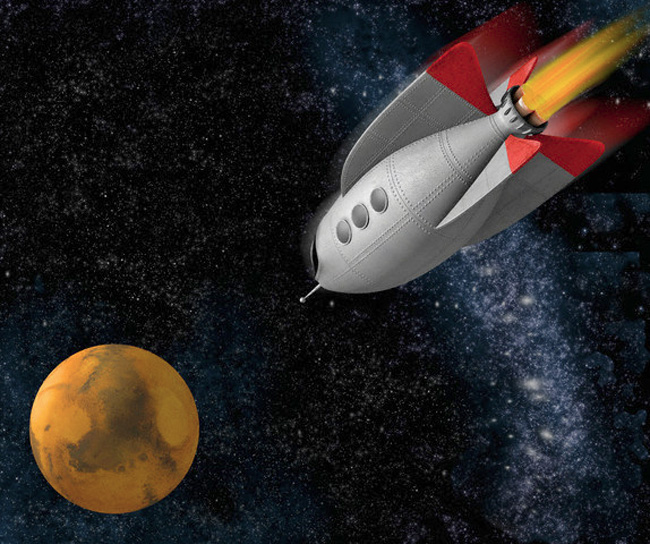
Rocketship to Mars. Credit: Flirt / SuperStock
Other factors to consider include the effects of prolonged weightlessness and psychological issues. 50 years of human spaceflight has led to a collection of countermeasures that seem to limit many (but not all) of the deleterious aspects of prolonged weightlessness. Exercise is more or less the prime countermeasure for bone and muscle loss although some pharmacologic approaches have been explored. To date the longest single exposure of a human as been 437 days. A 501 day mission would be only 2 months longer but not problematic per se.
Profiling
As for psychological issues ? the paper does make reference to them and suggests the possibly of putting candidate crews through a ground based simulation 6 months in duration ? and perhaps for the entire 500 day period. Given the fact that there are only 1,800 or so days until launch, expecting the flight crew to spend more than a third of that time simulating a full mission ? and then doing it again (for real) becomes problematic.
Sources report that it is the intention of Inspiration Mars to have a crew comprised of a man and a woman. Given that the prime purpose of this mission is to inspire people it follows that the crew actually represents everyone. While this is an assumption, it would follow that the crew is more likely to be a couple. Then the questions arises: can you and your significant other live inside a large RV for a year and a half without being able to totally get away from one another ? even for 5 minutes? If so, then you two should apply. Several of the Paragon authors on this paper (Taber MacCallum and Jane Poynter) are veterans of the 2-year Biosphere II mission ? so there is certainly some personal experience there.
Even if a robust spacecraft is designed with every contingency considered, time, cost, and mass will force some limits. It is unlikely that NASA would send a mission without significantly more redundancy and backup systems. But NASA is NASA. This is a private expedition ? not a NASA mission.

The likely view by the tourists hundreds of meres above Mars
Given that the crew are likely to be private citizens ? not government employees, they can decide to accept certain mission risks. No one really jumps in front of anyone wanting to climb Mt. Everest ? except, of course, journalists looking for an interview and government officials wanting so to be paid a climbing permit fee. So why should a totally private mission to another summit of sorts ? i.e. Mars ? be any different?
I have seen this sort of risk acceptance with my own eyes. In 2009 I spent a month living at an altitude of 17,600 feet at Everest Base Camp supporting Astronaut Scott Parazynski in his successful attempt to reach the summit. We both took physical risks ? Scott much more than I. But we both had to sign lots of lengthy waivers, bring lots of medications, risk sudden death from totally unexpected (and possibly untreatable) things (stroke, heart attack, or edema), and perform regular countermeasures designed to limit the increased physical risk we placed ourselves in by living and working at these altitudes. And there were thousands of people around us who accepted the same risks.
History?s Trails
Accepting known and increased personal risk is something that people have done as part of exploration since exploration began. Indeed, risk goes hand in hand with exploration. Again, we should allow ? and expect ? that the Inspiration Mars team will exercise the same personal acceptance process as other explorers have before them.
So why does Dennis Tito want to do this? You?ll have to ask him that. Again, one thing is clear: he?s looking to spend money on this ? not make money. He?s already made his money ? and (in case you still do not know who he is) has been there, done that when it comes to space travel. Tito was the first person to pay his own way into space back in 2001. He has the means to attempt this mission and he has a track record.
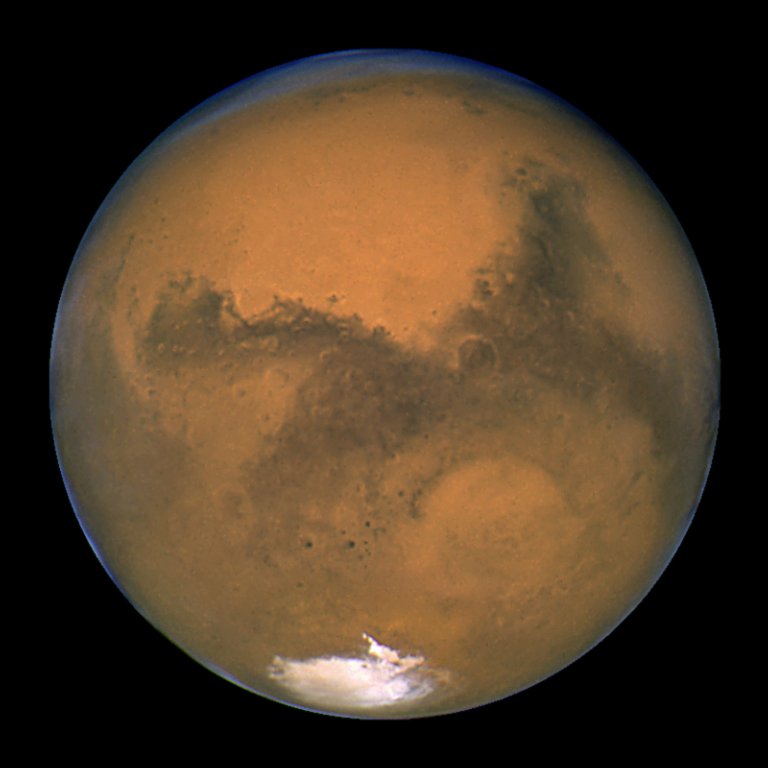
Mars from the Hubble telescope
Some insight into the rationale for this mission can be found in the IEEE paper: ?Sending humans on an expedition to Mars will be a defining event for humanity as well as an inspiration to our youth. Social media provides an opportunity for people to meaningfully participate in the mission, likely making this the most engaging human endeavor in modern history. The mission will address one of the most fundamental technical challenges facing human exploration of space, keeping the humans alive and productive in deep space.?
Given that NASA?s current plans (totally unfunded) to send humans to Mars are a decade or two away, and the human mission to an asteroid that NASA is supposed to be working on is uninteresting to the agency, yet another generation of Americans will likely grow up seeing people only going in circles overhead on the ISS.
The Inspiration Mars mission has the potential to jump start public interest in space again by actually going somewhere ? perhaps in a way that echoes what I and many others saw as young children in the 1960s as Apollo went from nothing to the finish line in a scant 8 years.
The public is interested in space. They always have been ? but that interest is episodic and often fickle. Public interest (and one would hope, inspiration) seems to manifest itself the most when NASA or other space agencies do something totally new or when new worlds are actually explored.
Despite the engineering accomplishment inherent in the ISS, it just goes in circles. Yes, it is a place where we learn how to do long duration missions (someday) but the preparation for these missions is like watching grass grow. Its hard to tell people that this will all lead to something decades from now.
But the mission contemplated by Inspiration Mars will actually do something ? and the launch date is easy to plan for. You can even set a calendar alarm for it on your iPhone.Source: SpaceRef
Source: http://www.davidreneke.com/how-dennis-tito-plans-to-send-people-to-mars/
earthquake los angeles unemployment 2012 nfl draft grades young justice nfl draft d rose iman shumpert


 Great discussions are par for the course here on Lifehacker. Each day, we highlight a discussion that is particularly helpful or insightful, along with other great discussions and reader questions you may have missed. Check out these discussions and add your own thoughts to make them even more wonderful!